> ## Documentation Index
> Fetch the complete documentation index at: https://docs.goakt.dev/llms.txt
> Use this file to discover all available pages before exploring further.
# Architecture Overview
> System design and component diagram.
## Bird's eye view
GoAkt is a framework for building **concurrent, distributed, and fault-tolerant systems** in Go using the actor model.
Every unit of computation is an **actor**—a lightweight, isolated entity that communicates exclusively through messages.
The [Actor System](/actor/actor-system) is the top-level runtime that hosts actors and orchestrates messaging, clustering, and lifecycle.
## Three deployment modes
| Mode | Description |
| -------------------- | ----------------------------------------------------------------------------------------------------------- |
| **Standalone** | Single process. Actors communicate in-process. |
| **Clustered** | Multiple nodes. Discovery via Consul, etcd, Kubernetes, NATS, mDNS, or static. Location-transparent actors. |
| **Multi-Datacenter** | Multiple clusters across DCs. Pluggable control plane (NATS JetStream or etcd). DC-aware placement. |
## Core building blocks
| Concept | Role |
| --------------------- | ------------------------------------------------------------------------------------------------------------------------------------------------------------------------------------------------------------------------------------------------------------------ |
| **Reactive stream** | Composable `stream.Source` → `Flow` stages → `Sink` pipelines, materialized with `RunnableGraph.Run` on an `ActorSystem`. Stages run as actors with demand-driven backpressure. See [Streams](/advanced/streams). |
| **CRDT / Replicator** | Conflict-free replicated data types (`crdt` package), merged by a per-node **Replicator** system actor. Replication is **eventually consistent**—separate from the Olric actor/grain registry (quorum-strong). See [Distributed data](/advanced/distributed-data). |
## Message flow
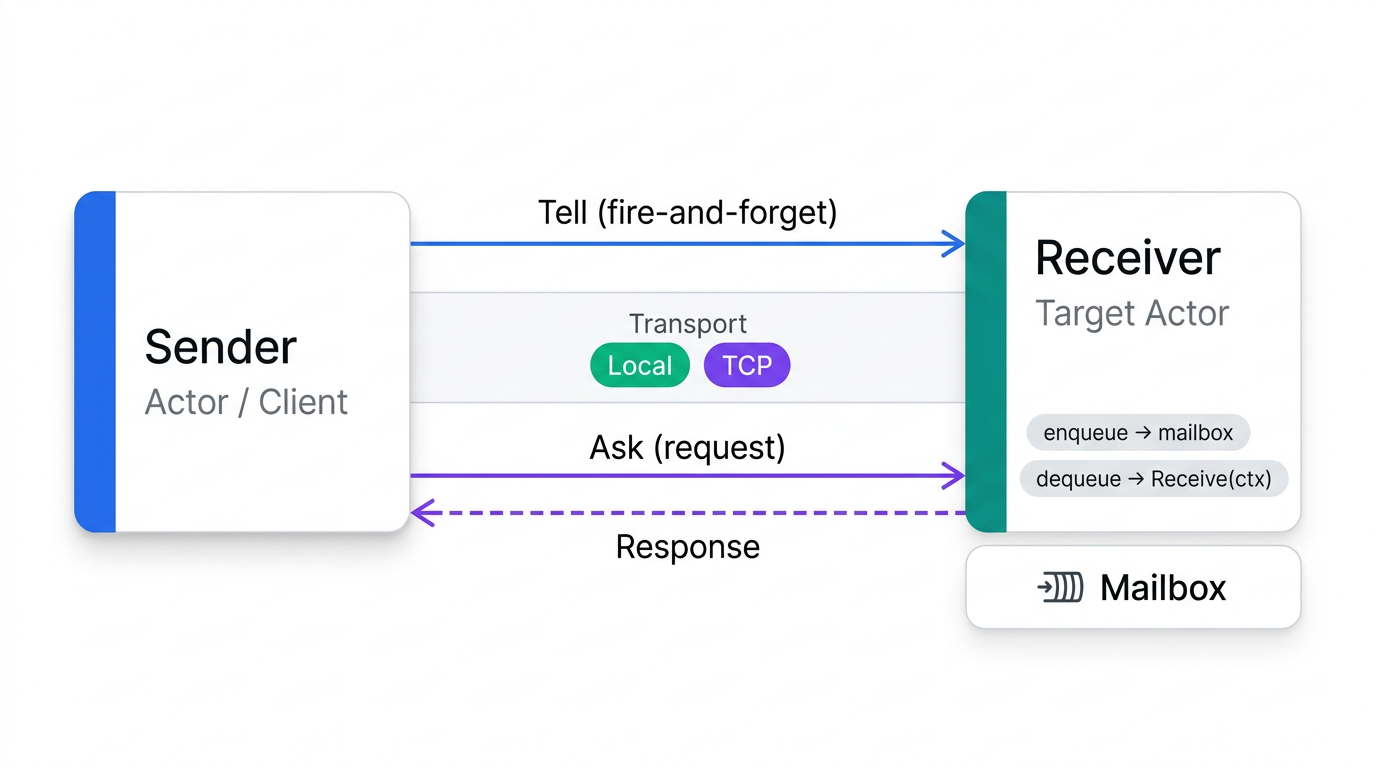 For remote messages, the remoting layer serializes the payload over a custom TCP frame protocol with optional
compression.
## Actor hierarchy
For remote messages, the remoting layer serializes the payload over a custom TCP frame protocol with optional
compression.
## Actor hierarchy
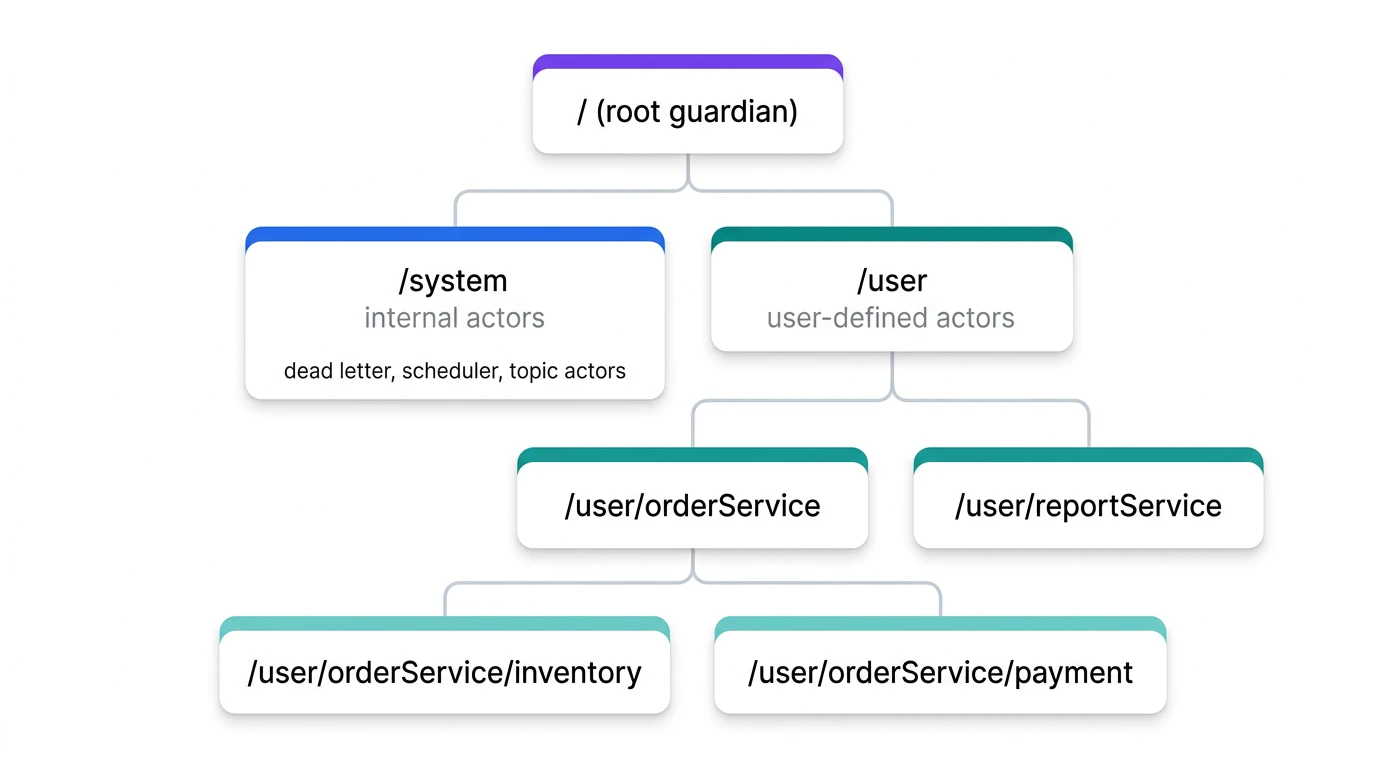 When a parent stops, all children stop first (depth-first). A parent supervises its children.
## Cluster architecture
When a parent stops, all children stop first (depth-first). A parent supervises its children.
## Cluster architecture
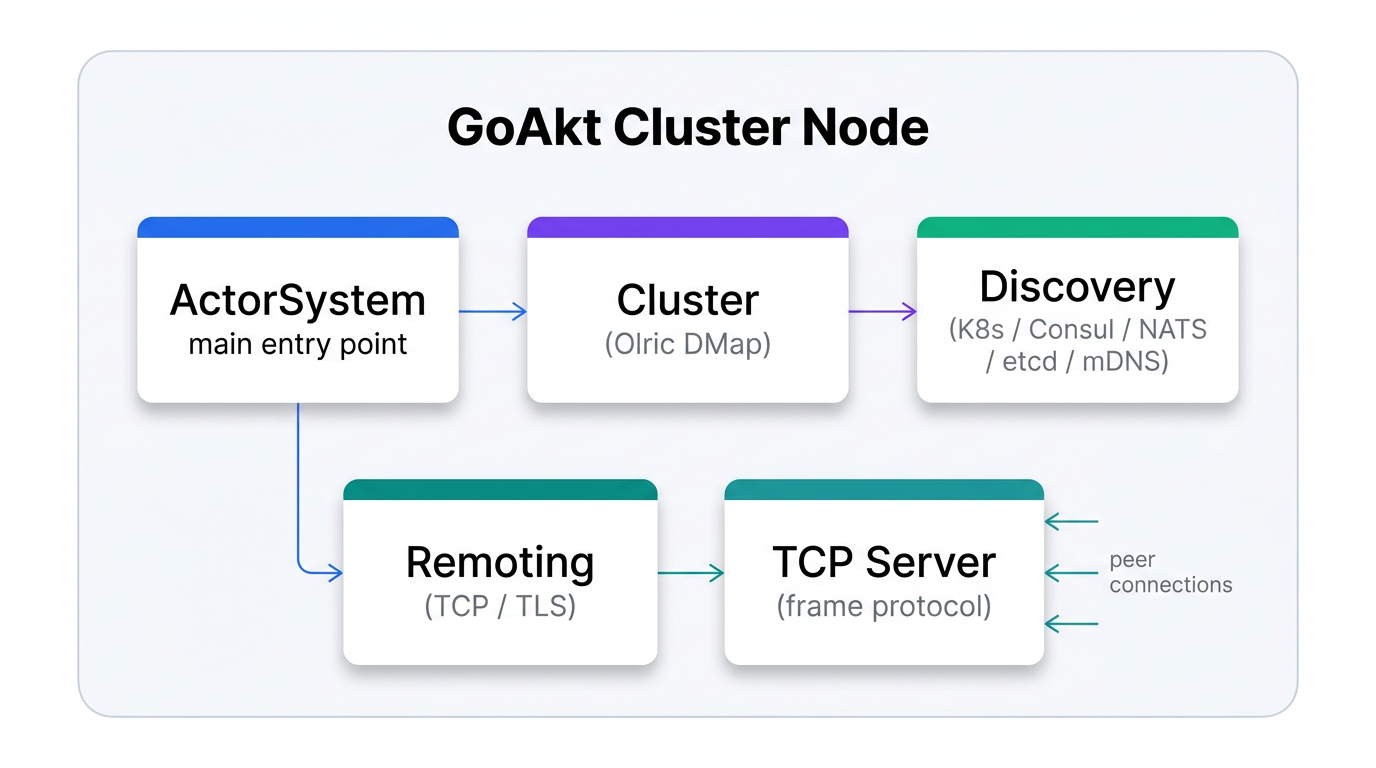 **Placement and membership** state (which actors and grains live where) is stored in Olric (distributed hash map) with configurable quorum. Node membership uses Hashicorp Memberlist. **CRDT application state** (when enabled via `ClusterConfig.WithCRDT`) is replicated separately by the **Replicator** actor using delta broadcast over the topic bus—not through Olric DMap writes.
## Deep dives
The following pages describe the internal architecture of each major subsystem:
| Subsystem | Page | What it covers |
| ------------- | ------------------------------------------------ | --------------------------------------------------------------------------------------------------------------- |
| **Scheduler** | [Dispatcher Pool](/architecture/dispatcher-pool) | Fixed worker pool, actor state machine, ready queue, work stealing, system-message priority, throughput tuning. |
## See also
* [Code Map](/architecture/code-map) — package layout and file-level responsibilities
* [Design Decisions](/architecture/design-decisions) — rationale behind architectural choices
**Placement and membership** state (which actors and grains live where) is stored in Olric (distributed hash map) with configurable quorum. Node membership uses Hashicorp Memberlist. **CRDT application state** (when enabled via `ClusterConfig.WithCRDT`) is replicated separately by the **Replicator** actor using delta broadcast over the topic bus—not through Olric DMap writes.
## Deep dives
The following pages describe the internal architecture of each major subsystem:
| Subsystem | Page | What it covers |
| ------------- | ------------------------------------------------ | --------------------------------------------------------------------------------------------------------------- |
| **Scheduler** | [Dispatcher Pool](/architecture/dispatcher-pool) | Fixed worker pool, actor state machine, ready queue, work stealing, system-message priority, throughput tuning. |
## See also
* [Code Map](/architecture/code-map) — package layout and file-level responsibilities
* [Design Decisions](/architecture/design-decisions) — rationale behind architectural choices